We get positively giddy when a container of Châteauneuf-du-Pape hits the warehouse. Like, hop-on-a-pallet-and-start-flossing giddy. It’s not our best look, but it’s worth the embarrassment we cause the younger warehouse crew.
That’s because Châteauneuf is — without question — one of the most flat-out enjoyable wines on the planet.
Even Robert Parker knows what’s up. He built his reputation on Bordeaux, but these days he’s reaching for CdP instead. Turns out waiting 20+ years for First Growths loses some of its charm as the birthdays stack up.
“As I’ve grown older I’ve developed an appreciation for wines that are immediately gratifying but that can also provide great satisfaction over several years… Today, the wine that I find myself turning to most often is Châteauneuf-du-Pape.”
— Robert Parker
That pretty much nails it. With enough depth and complexity to keep serious collectors engaged — but enough generosity that a novice can take a sip and confidently declare, “damn, that’s good” — Châteauneuf walks the line better than almost any collectible wine. It’s delicious on release, built to age for a decade or more, and still relatively affordable when you stack it up against classified Bordeaux or cult Napa Cabernet.
Background
The name “Chateauneuf-du-Pape” means “new castle of the pope” and refers to a time in history when the Catholic church moved the pope from Rome to the walled city of Avignon, France, in the 14th century. Today the bottles still retain the distinctive papal regalia embossed on the glass.
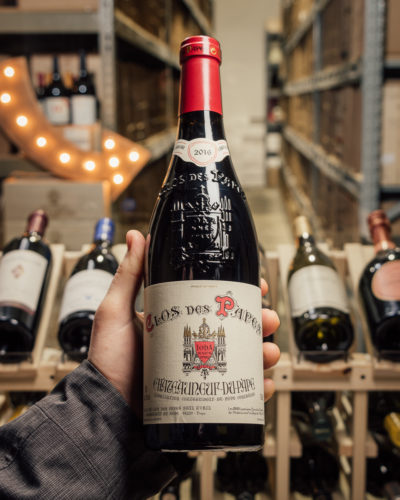
Clos des Papes is arguably one of the finest examples around.
Positioned at the very south of the Rhone region, Chateauneuf shares very little in common with its northern counterparts. In the north, in cooler places like Cote-Rotie and Hermitage, Syrah plays the central role. Here in the south, it’s all about Grenache. As they say, in Grenache we trust.
Terroir
Everything about Châteauneuf conspires to make powerful, expressive wine.
The Rhône River borders the west, Mount Ventoux looms to the east, and rolling hills connect four ancient villages across the appellation. At first glance, it doesn’t scream “world-class vineyard.” Many plots are littered with large, rounded stones known as galets roulés, leftovers from ancient glacial activity.
Those stones are doing real work. They soak up heat during the day, radiate it back at night to help grapes ripen, and protect the soil beneath by locking in what little moisture there is.
Spend enough time with Châteauneuf and you’ll hear the term garrigue. It describes the wild herbs — rosemary, thyme, oregano, marjoram — that grow all over the region, often right between the vine rows. Their aromatic oils work their way into the wines, lending that unmistakable savory edge.
Then there’s the mistral. A bone-chilling wind that barrels down from the Alps at 30–50 mph, scrubbing the vineyards clean of pests, mold, and mildew while cooling vines during brutal heat waves. It’s nature’s pressure washer.
And yes, it gets hot. Very hot. Some of the warmest temperatures in France live here, which is why 15–16% alcohol isn’t unusual. These wines are unapologetically powerful.
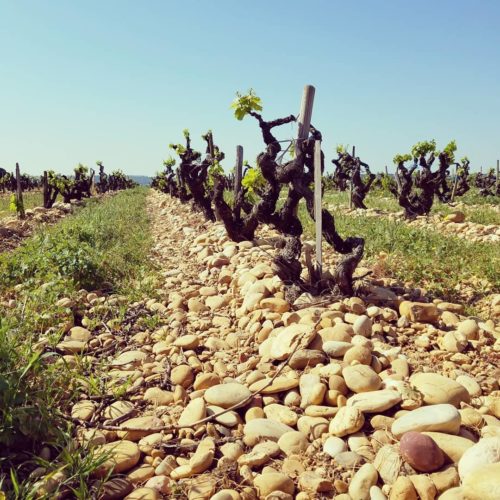
CdP's soils are comprised of large, rounded stones known as galets roulés, leftovers from ancient glacial activity.
Grapes & Vinification
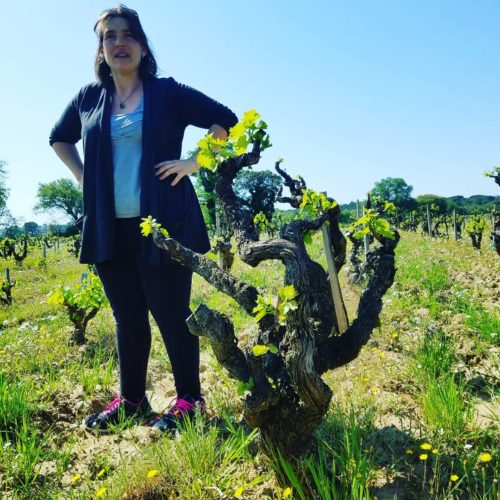
Nathalie Reynaud of L’Abbe Dine stands next to old-vine Grenache in one of her vineyards.
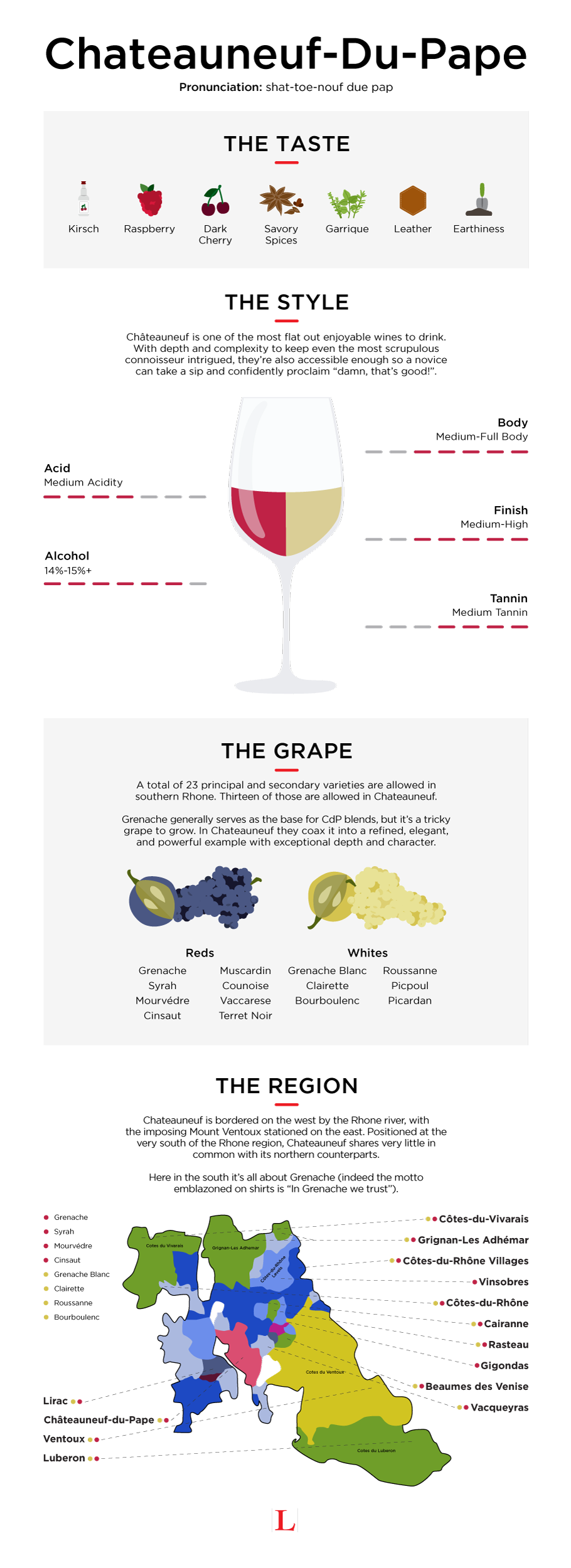
hirteen grape varieties are permitted in Châteauneuf-du-Pape — out of 23 allowed across the Southern Rhône.
Red varieties: Grenache, Syrah, Mourvèdre, Cinsault, Counoise, Vaccarèse, Muscardin, Terret Noir
White varieties: Grenache Blanc, Clairette, Bourboulenc, Roussanne, Picpoul, Picardan
Grenache is the backbone, but it’s a tricky grape. Treated poorly, it can come off thin and one-dimensional or overripe and hot. In Châteauneuf, however, it’s coaxed into something refined yet powerful, with serious depth.
Typical flavor profiles include kirsch, raspberry, and dark cherry layered with savory spices, leather, and earthy notes. That little hint of funk you sometimes encounter? That’s often Brettanomyces — polarizing, controversial, and undeniably part of the Southern Rhône signature. If a wine smells barnyard-y on opening, give it an hour or two to breathe and it usually settles down.
Organic and sustainable farming is the norm, irrigation is tightly restricted, and most vines are dry-farmed old vines. Yields are strictly limited to 368 gallons per acre — about half of what Bordeaux allows — keeping concentration high.
Vinification often happens in concrete, since Châteauneuf is prone to oxidation. Heavy oak is rare, which makes these wines incredibly food-friendly. Some producers lean lighter and more aromatic, almost Burgundian in feel, while others chase power and density.
Whites — often overlooked — are produced in much smaller quantities but can show serious depth. The benchmark example is Château de Beaucastel’s 100% Roussanne, a wine that combines richness, aromatics, and surprising longevity.
Top producers include Château de Beaucastel, Château Rayas, La Nerthe, Domaine du Pegau, Vieux Donjon, Les Cailloux, and Vieux Télégraphe. There are also plenty of under-the-radar gems from smaller families, including L’Abbé Dine, Château Serguier, Château Mont Thabor, Ferme du Mont, Clos des Papes, Domaine de la Janasse, and Domaine Marcoux.
Finally, vintages matter. Standouts include 2015 and 2016 — truly off-the-meter years — along with 2007, 2005, 2001, and 1998. If you’re looking to dip your toes into Châteauneuf-du-Pape, start there and you won’t be disappointed, and you'll be feeling fine like wine.
“Like a bottle of Châteauneuf–du–Pape, I’m fine like wine”
— Beastie Boys, Body Movin’