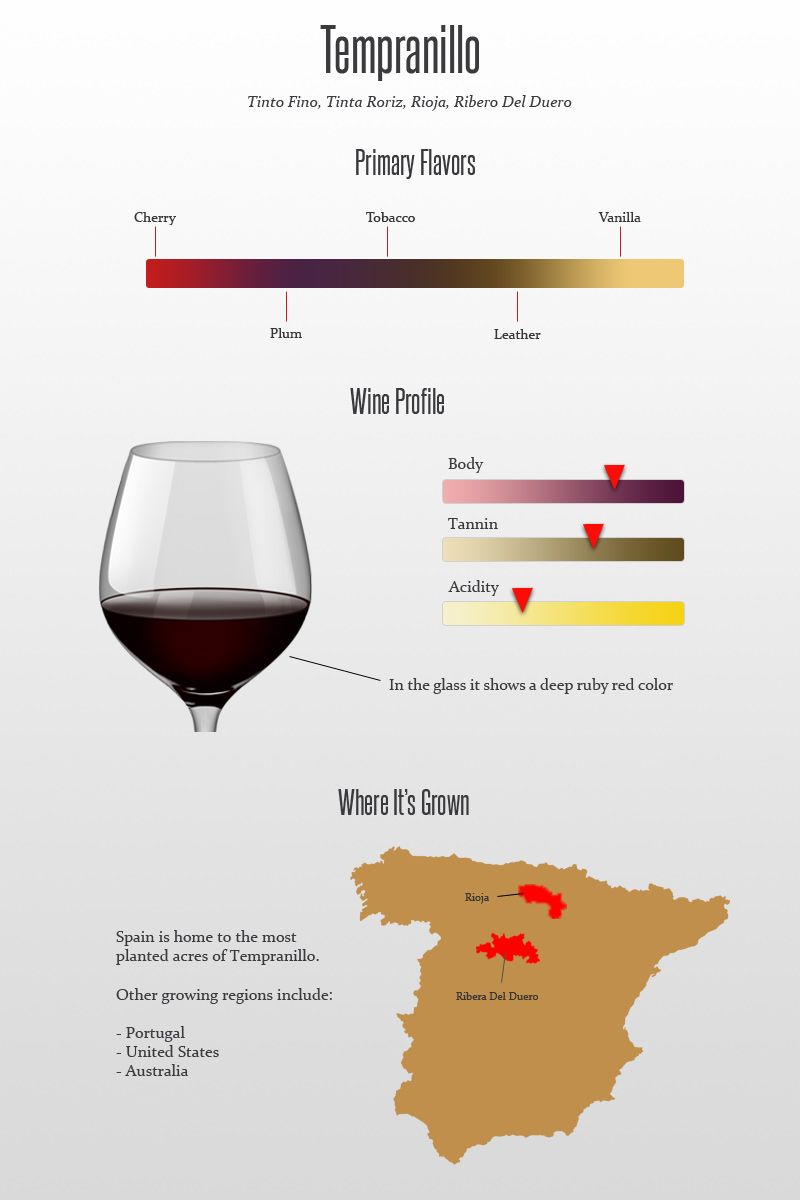
On November 12, people around the world will celebrate Tempranillo Day, and it only makes sense that we do a quick profile of this wonderful and quite underrated varietal. While not as dominant in the marketplace as Cabernet or Merlot, for example, Tempranillo enjoys broad appeal thanks to its forward flavors and wide range of food pairing options. Its flavors range depending on the style, but it tends to lean toward the savory and rustic side of things. It's a complex wine with leather, tobacco, peaty earth, and vanilla all sharing the stage alongside a backbone of both red and black fruits.
Rioja versus Ribera
There are more than 500,000 acres of Tempranillo planted worldwide, but Spain is the grape's stomping grounds, accounting for at least half that acreage. Two regions in Spain dominate the production, Ribera Del Duero and Rioja. Despite their close proximity, just like in the Left and Right Bank of Bordeaux, the style from both of these areas differs significantly. Rioja delivers a more refined style with lighter color, higher acidity, and brighter red fruit. Meanwhile, in Ribera you can expect more concentrated dark red and black fruit notes and a fuller body with a bit less acidity.
Historically, Rioja wine has been modeled after Bordeaux. It was made using a blend of grapes, Tempranillo mostly, with a balance of Garnacha to plump up the fruit and maybe a sprinkling of Graciano or Carignan, and in lesser quantities, Monastel. Tempranillo is to Rioja what Cabernet is to Bordeaux blends, serving as the foundation, but rarely the whole, of a wine.
Until the 1990s, almost all Rioja was aged in small American oak barrels, which often smothered the resulting wine in a generic vanilla and coconut-scented robe. This practice began way back around 1850 when Marques de Murriet and Marques de Riscal decided they could save a few bucks by importing American oak and fashioning their own barrels instead of buying pricey French oak. Today, some wineries like Murrieta, La Rioja Alta, and Lopez de Heredia still use 100% American oak. Most Rioja wineries use either all French or a mix of French and American oak barrels, which better showcases the fruit. It has also become more common (although still rare, relatively speaking) to see 100% Tempranillo instead of blends, although most Rioja producers still favor blending. Overall, the result has been a wider split between modern and traditional styles. The so-called traditional wines age for a long time in used American oak, while the modern "alta expresion" (meaning "high expression") wines come from riper grapes that spend less time in new French oak. Still, the traditionalists seem to be the de facto standard, and wines from Rioja spend on average anywhere from 3-6 years in barrel, much longer than you'd find in California or France.
 Tempranillo Wine Grapes | Photo © VinoFamily
In Ribera del Duero, they refer to Tempranillo as "Tinto Fino" or "Tinta del Pais," and it's a clone that's adapted specifically to perform in that region. The main difference between Rioja and Ribera del Duero comes from the geography and climate. Ribera grapes are grown at higher altitude with less rainfall. It's also hotter. This means the grapes have thicker skins and smaller berries, resulting in concentrated, dense, and ripe wines with less acidity. They also don't have the same strict aging rules as Rioja. Compared to Rioja, the wines from Ribera del Duero seem riper, flabby, and plush without as much elegance or expression of terroir. Elsewhere, in Toro, they refer to Tempranillo as "Tinto de Toro," where they craft an easy-drinking variation that shows a more youthful, exuberant side of Tempranillo. And although Spain is the predominant region for Tempranillo, it also extends its roots in other places like Portugal, Argentina, Australia, and United States.
Classifications of Tempranillo:
In Rioja, these Tempranillo classifications are the rule, not the exception. In Ribera, although most producers follow similar classification rules, they are not explicitly required to do so.
Crianza
Requires at least two years aging, with six months in oak. Many producers use French or American oak to impart a greater depth of flavor.
Reserva
Must spend three years total aging, with at least one of those years in oak. Because of the extra time in wood, Reserva has even bigger and bolder flavors with more tannins.
Gran Reserva
Only warranted if a particular vintage is deemed good enough. This classification requires five years of aging, with a minimum of 18 months in oak.
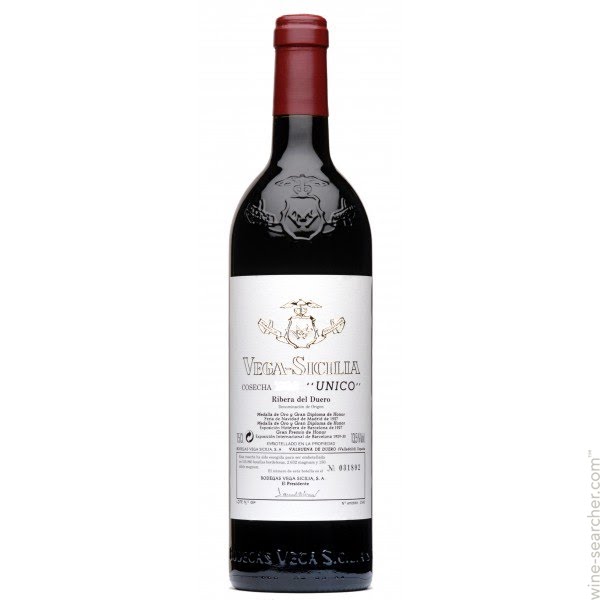
Vega Sicilia is a collector favorite, and their Gran Reserva is usually released 10-15 years after the vintage.
Pairing Food With Tempranillo
Think rustic. The local food in both Rioja and Ribera centers around things like roasted lamb, white asparagus, and other hearty dishes. Thanks to its savory character, you can pair Tempranillo with plenty of foods, from hamburgers and lasagna to braised meats and pizza. It goes particularly well with mildly spicy Cajun or Indian style dishes, lamb roasts, and stews.
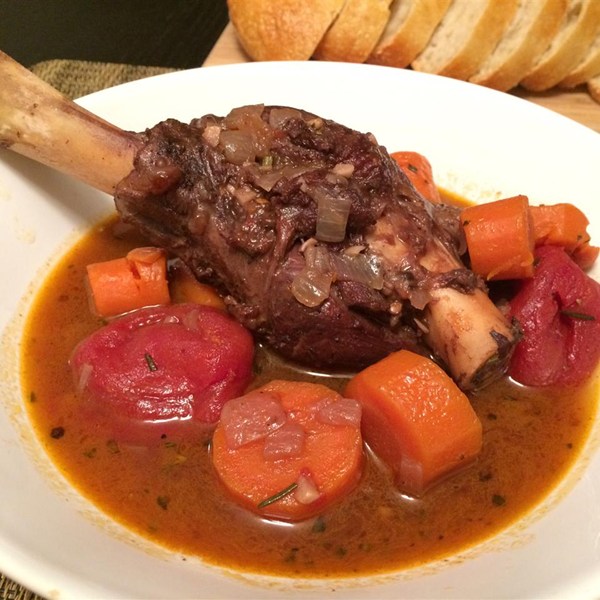 Try some of these recipes for a perfect Tempranillo pairing: Hanger steak with shallots and mushrooms, Rosemary braised lamb shanks, or Moussakka

The 2011 Tinto Figuero Tempranillo Ribera del Duero 12 is beautifully balanced, never heavy, and loaded with silky red fruits, lavender, hot cocoa, and that really awesome Australian licorice with some vanilla on the back end.
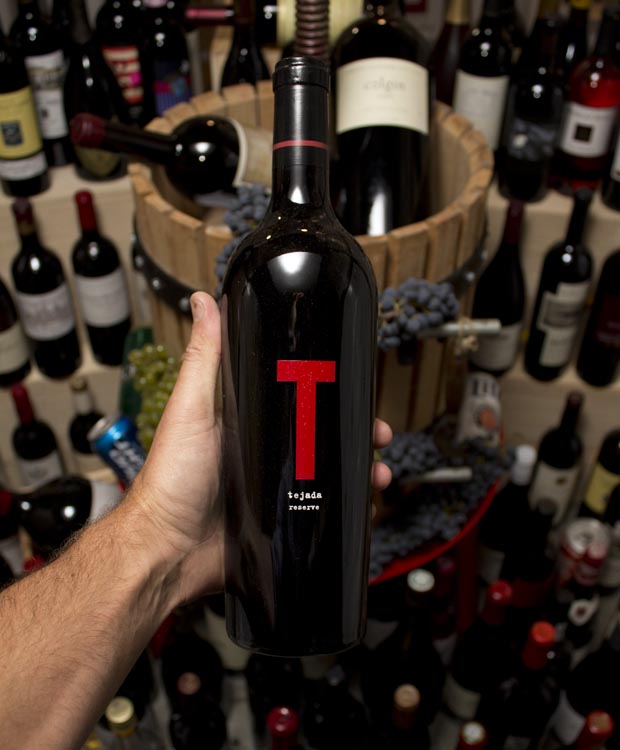
Tejada Tempranillo Reserve 2006 offers a robust profile of maraschino cherry, crushed fresh black cherries, sweet tobacco, earth, and some spicy, exotic oak notes of smoky herbs and clove, all in a perfectly soft, savory, round mouthfeel.
Of course, the most notable producers include Vega Sicilia, Marques de Riscal, R. Lopez de Heredia, and Ysios to name a few!
Additional Resources: Find out about Spanish Wine on Catavino.net