We import some great wines from a gang of terrific producers in Chateauneuf-du-Pape. While we can't pick a favorite (they're all good or we wouldn't waste our time!), we can say Mont Thabor is for sure high in our book of amazing discoveries. And not just because Daniel Stehlin has one of the most epic moustaches in the Rhone Valley.
The Vineyards
We rolled into Mont Thabor on a sunny spring morning during our recent trip in March. After arriving at the winery, the three of us squeezed into the back seat of his old Land Cruiser and set off on a tour of his vineyards with Daniel and his daughter.
As we drove by La Nerthe, Daniel casually mentioned that when his family originally bought land in the region, they turned down that very same parcel on which the now famous chateau occupies. He shrugges it off, not even considering it a missed opportunity. Why should he? After all, his family owns around ten acres of prime Chateauneuf vineyards, stocked with Syrah, Counoise, Mourvedre, and of course, the grandaddy of them all, 70-year-old Grenache vines. Add another 15+ acres in nearby Cotes du Rhone, and it's pretty clear he has perfect foundation to churn out some killer wine.
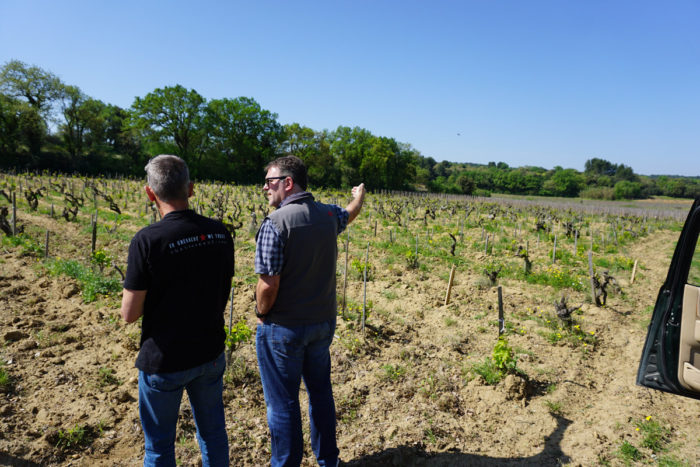 Daniel seems to know every inch of the 70+ year old vineyards.
CdP is famous for high-octane wines that deliver big, ripe, and complex flavors. One reason these wines are so intensely concentrated comes down to the AOC rules, which cap yields at 368 gallons per acre — nearly half of what’s allowed in Bordeaux. Then there’s the old-vine Grenache, which makes up roughly 70% of the plantings in the region. As these vines age, they produce less fruit, but the berries punch way above their weight in flavor. Finally, irrigation is strictly limited — growers can water only twice per year, and only if absolutely necessary — so most of this old-vine fruit is effectively dry-farmed.
The Estate
Mont Thabor is humble compared to its famous neighbors. No grand sign on the road. No castle on a hill. It’s not a tourist destination like La Nerthe, Vieux Télégraphe, or Château Rayas, which is part of its charm. The name “Mont Thabor” comes from one of the most famous mountains in Galilee, Israel.
In 1881, Daniel’s great-uncle Fritz Stehelin purchased the estate, which included a beautiful old French farmhouse and a stable that he immediately converted into a winemaking cellar. In 1940, Luc Stehelin took over from Fritz and planted new vines in the Côtes du Rhône. Daniel assumed the reins in 1977, and today the estate remains a family affair, with his daughter helping alongside him.
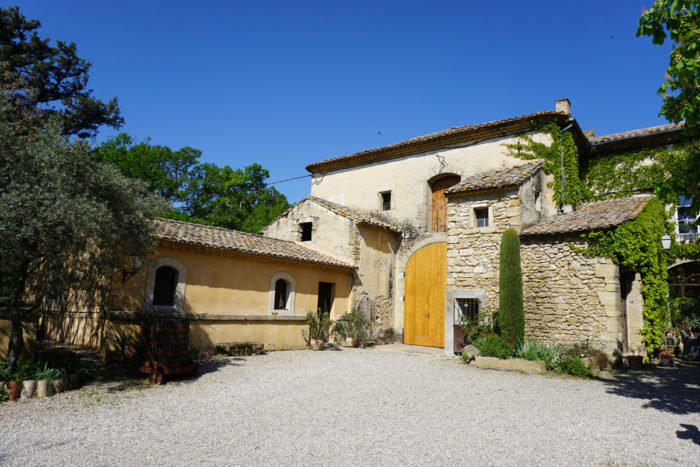 Originally used as a stable but now serving a much better purpose (at least in our opinion!).
Surprisingly, it wasn't until 2001 that he stopped selling wine to negociants and began making estate wines. Parker awarded 90 points to his second vintage, and the high praise and high scores have continued since then. It seems he made the right choice!
The Family
This is a 100% family-owned and operated estate, with Daniel at the helm and his daughter by his side. Daniel is humble but proud, full of positive energy and just an all-around super-friendly guy. After touring the vineyards, we returned to dine al fresco in the warm spring sun alongside his two daughters. There, we enjoyed a seasonal lunch of sliced beets, roasted asparagus, and braised beef with potatoes lyonnaise, all lovingly prepared by his wife.
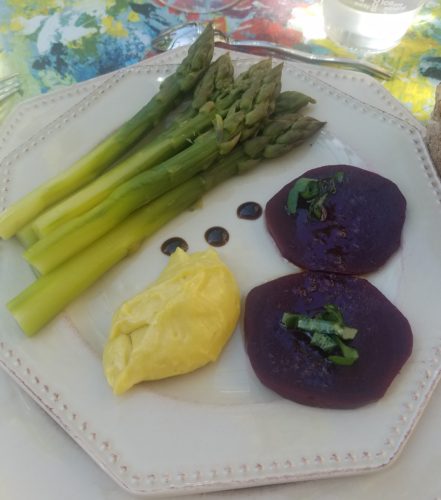
Daniel's wife served up a delicious lunch, starting with some fresh asparagus and sliced beets drizzled with a bit of olive oil and balsamic.
The Wine
During our visit, we tasted samples of the 2015 and 2016 wines. In a word? EPIC! No doubt these vintages will go down in history as two of the best in several decades. Let this be your formal notice to stock up as much 2015 and 2016 Rhone wine as you can!
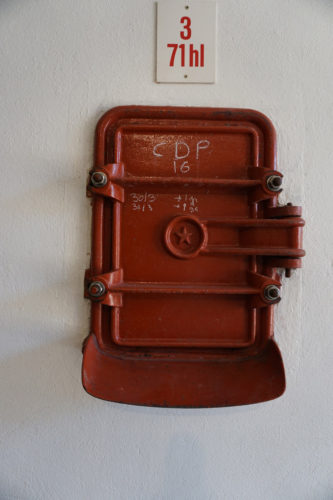
The latest vintage of Chateauneuf-du-Pape resting in cement tanks.
Back to Daniel's wines. Polished, lush, and leaning toward the more traditional style, they are, as Robert Parker put it, "gutsy" and deliver everything we love about Chateauneuf. Up front it's an orchestra of red fruit with kirsch, raspberry, maraschino cherry, red whips, and red plums, accompanied by a chamber of brambly blackberry, spice box, crushed sweet herbs, and anise.
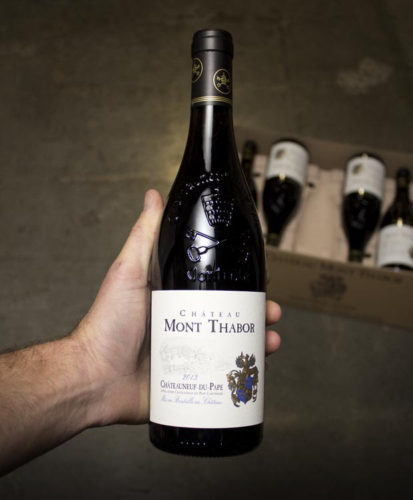 Deep, intense, and a bit wild with round, dark blue fruits and a peppery, wild herb note, followed by anise and mint and spice.
He ages two-thirds of the Châteauneuf-du-Pape in barrel, leaving the remaining one-third in the tank for 12 months. After harvest, Daniel ferments using mostly whole stems — adding a sense of freshness to the final wine, along with a touch of extra tannin that helps firm up its structure. Fermentation continues for about four weeks in large concrete tanks, and the remainder of aging takes place in a mix of oak barrels and concrete tanks. The final blend is usually 70–80% Grenache, around 20% Syrah, with a small percentage of other grapes like Mourvèdre, Counoise, and Cinsault.
"The 2007 Mont Thabor Châteauneuf-du-Pape displays the vintage’s very sexy, full-bodied, fruit-driven style, with the purity and freshness of the wine’s corpulent personality. Classic old-vine Grenache shows plenty of kirsch, licorice, and garrigue — a seductive style that should drink beautifully for at least a decade."
— Robert M. Parker, Jr. on the 2007 Mont Thabor Châteauneuf-du-Pape Rouge
Although Daniel’s wines have earned plenty of critical praise, he seems more focused on making what he enjoys, in a style that best flaunts the grapes’ personality. Unlike some other producers in the region, he doesn’t make a separate, higher-level Châteauneuf, so you know he’s putting all the best fruit and attention into the single wine he produces.
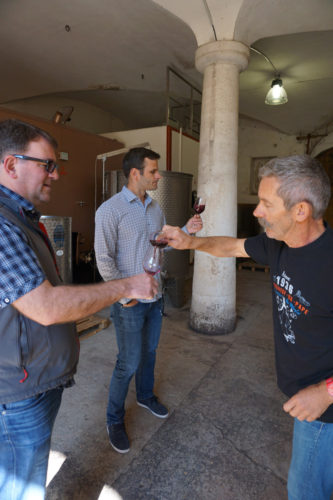
Tasting tank samples of the 2015 and 2016 vintages.
You know what we love most about the wine world, besides the wine itself? The people. Daniel Stehelin is a prime example — approachable, sincere, and the kind of guy you’d instantly trust on the other end of a belay climbing Everest. Since he doesn’t have a massive castle or sprawling, perfectly manicured lawns to factor into the price, his wines are always screaming bargains, drinking far above their price point. Needless to say, we’re thrilled to bring Mont Thabor wines to the U.S. The only downside? We wish there was more to go around!