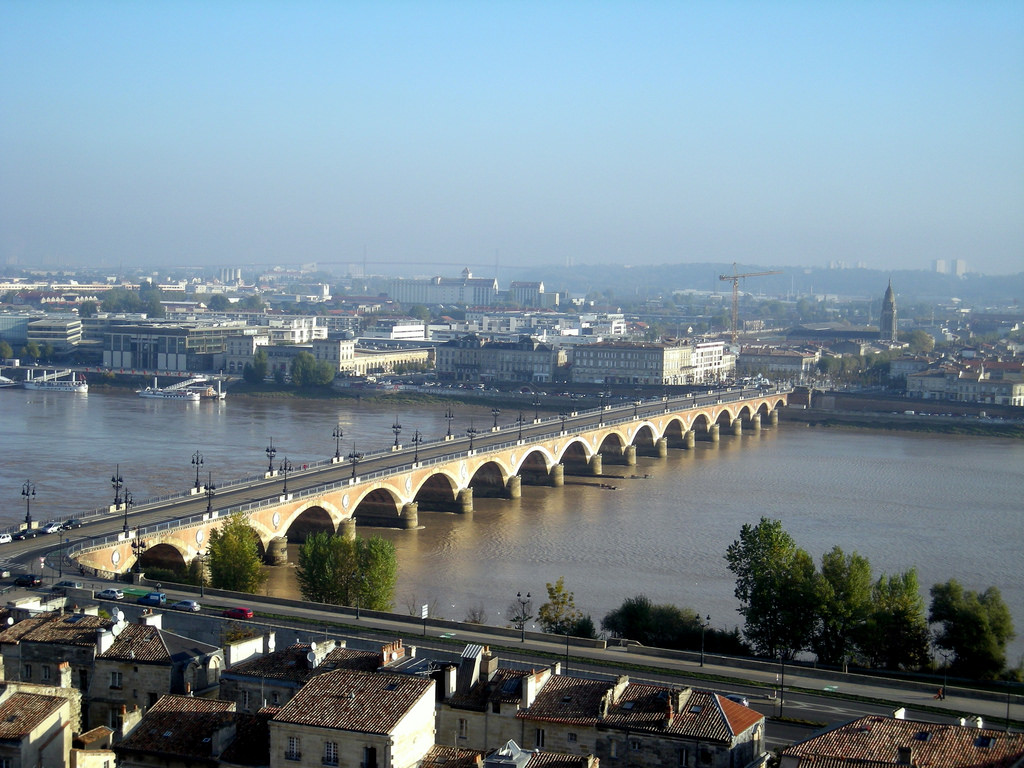
 On a basic level, regions in Bordeaux can be understood by their relation to the Gironde river. Photo by Dhinal Chheda
In Bordeaux, the Left Bank and Right Bank refer to the two sides of the Gironde estuary and its tributaries, the Dordogne and the Garonne. Vineyards located north and east of the rivers make up the Right Bank, while those to the south and west fall on the Left Bank.
Between the two sits Entre-Deux-Mers, which literally translates to “between two seas," a wide middle zone that skips the prestige but consistently delivers some of Bordeaux’s best values.
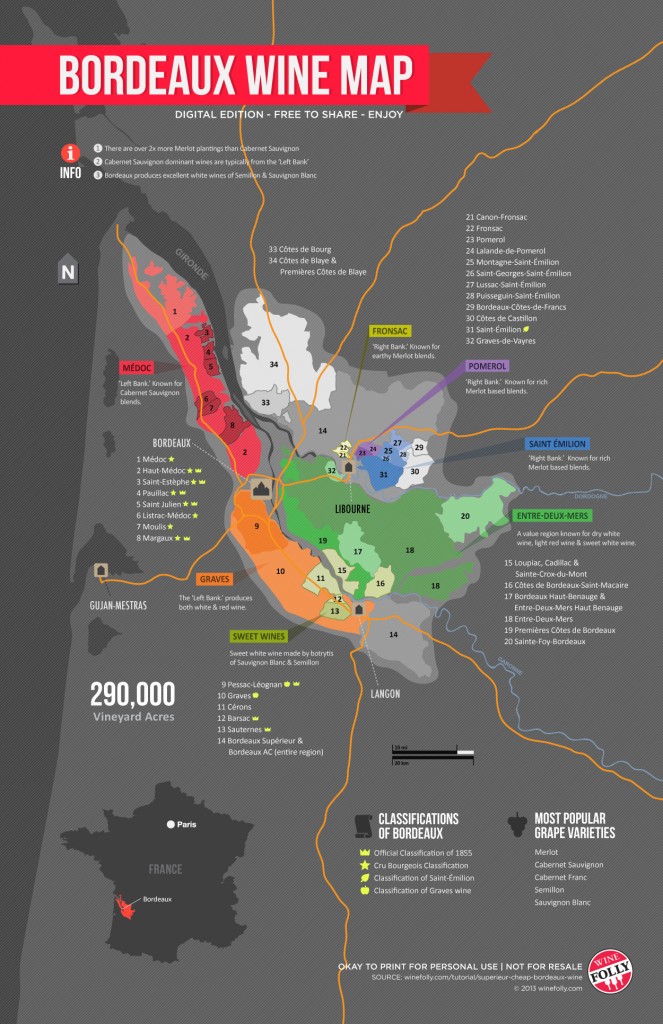 Via Wine Folly. With nearly 300,000 acres of vines and 1.5% of the world's total production, Bordeaux wines yield a disproportionate 10% of the dollar value of all wine exports.
Left Bank
The Left Bank is the old guard of Bordeaux, home to the region’s most famous and exclusive châteaux. Wines here are typically Cabernet Sauvignon–driven, known for firm structure, serious tannins, and the kind of longevity that rewards patience. They also tend to command the highest prices.
The Left Bank of Bordeaux is most known for the legendary classified growths, including every First Growth from the 1855 Classification. Names like Lafite Rothschild, Mouton Rothschild, and Haut-Brion set the global benchmark for Bordeaux.
Cabernet Sauvignon leads the blend, supported by smaller amounts of Merlot, Cabernet Franc, Petit Verdot, and Malbec. Left Bank terroir is generally flat terrain with gravel-dominated soils over limestone. While the framework is consistent, soil composition can change dramatically from one vineyard plot to the next.
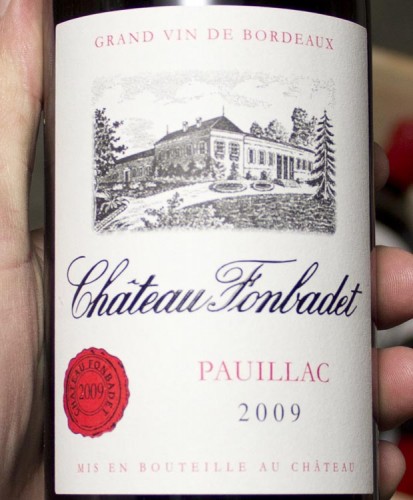
Chateau Fonbadet Pauillac 2009. Black currants, juniper, blueberry extract, stones, and sweet crushed herbs, with a dash of the pencil lead and cigar box spice. The texture is full and round with a long spicy finish.
Left Bank AOCs to Know
Médoc
Divided into Médoc and Haut-Médoc, this is classic Left Bank territory. It’s home to many of Bordeaux’s most expensive and celebrated châteaux, but also produces plenty of lighter, value-driven reds meant for near-term drinking.
Graves
Overall quality can be inconsistent, with one very notable exception. Graves is home to Haut-Brion, the only First Growth located outside the Médoc.
Saint-Estèphe
Known for powerful, tannic wines with serious structure and long aging potential.
Pauillac
Often considered the most famous appellation in Bordeaux. This is where intensity, structure, and pedigree converge.
Saint-Julien
The smallest Médoc commune, prized for its high standards and remarkably consistent quality across producers.
Sauternes
A unique microclimate brings higher humidity to the vineyards, enabling the development of noble rot and producing some of the world’s most elegant and long-lived dessert wines.
Right Bank
For decades, the Right Bank lived in the shadow of its neighbors across the river. That changed when Robert Parker began championing a more modern, garagiste approach embraced by many local producers. His high scores helped shine a spotlight on wines built for richness and early appeal rather than long, cellar-bound aging.
Right Bank wines tend to be fruit-forward, softer in structure, and lower in tannin and acidity. The result is a style that’s often more approachable in its youth and easier to love straight out of the bottle.
The Right Bank is most known for a more artisanal, garagiste sensibility with small, family-run estates taking the place of grand, historic châteaux. The region’s popularity surged as Parker’s praise put these wines on the global map.
In terms of grapes, Merlot dominates, supported by generous amounts of Cabernet Franc and smaller contributions from Petit Verdot, Malbec, and Cabernet Sauvignon. These blends lean toward a softer texture, richer fruit profile, and less aggressive tannin. Right Bank terroir features limestone-rich soils with more clay and less gravel, an ideal match for Merlot. Vineyards are mostly flat, broken into smaller parcels, and retain a distinctly agricultural, hands-on feel.
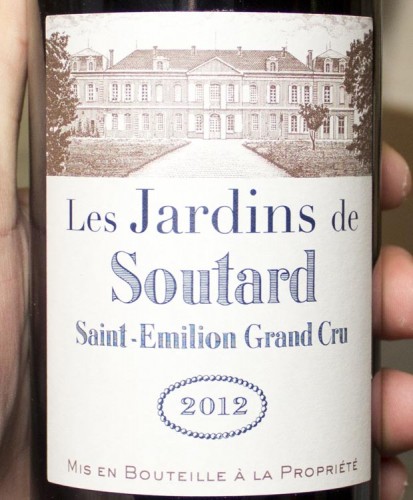
Les Jardins de Soutard St Emilion Grand Cru 2012. Spicy, perfumy red fruits explode with notes of cranberry juice, pomegranate, fresh plums, and red currant jam.
Right Bank AOCs to know
Pomerol
With just 900 producers, Pomerol is one of Bordeaux’s smallest appellations, yet it turns out some of the most expensive wines in the region. It’s also the only major Bordeaux AOC without a formal classification system. Merlot thrives on the plateau here, best exemplified by the area’s most famous estate, Pétrus. Its 100 percent Merlot is widely considered the gold standard for the grape.
Saint-Émilion
High-elevation plateaus of sand, clay, and limestone create ideal conditions for Merlot, resulting in opulent, fruit-driven wines. While the top estates command serious prices, surrounding appellations like Lussac-Saint-Émilion, Montagne-Saint-Émilion, and Saint-Georges-Saint-Émilion offer excellent value.
All Saint-Émilion producers may use the “Grand Cru” designation, but the classification system goes further. At the top sit four châteaux — Angélus, Pavie, Cheval Blanc, and Ausone — holding Premier Grand Cru Classé A status. Below them are a larger group classified as Premier Grand Cru Classé B.
Margaux
Located in the Haut-Médoc on the Left Bank, Margaux is home to Château Margaux, one of the original Premier Crus from the 1855 Classification and one of Bordeaux’s most elegant expressions of Cabernet Sauvignon.
Bordeaux Classification
Like most of France, Bordeaux operates under a rigid classification system that influences price, prestige, and perceived quality. The full story could fill a book, but here’s the short version that actually matters.
1855 Official Classification
Covers red wines from the Médoc and sweet wines from Sauternes. Estates are ranked from First Growth to Fifth Growth, originally based on market price.
Saint-Émilion Classification
First established in 1955 and revised roughly every ten years. Producers can be promoted or demoted, making it far more fluid and controversial than the Médoc system.
Graves Classification
Introduced in 1959 to bring structure to the region. Unlike the 1855 system, it does not rank estates by growth level.
Cru Bourgeois
Created in 2003 to recognize quality producers outside the classified growths. It was discontinued in 2009 after legal challenges, then later reintroduced in revised forms.
Bordeaux AOC and Bordeaux Supérieur
Over half of all Bordeaux wine falls into these broad categories, overseen by the Syndicat des AOC. Quality ranges from serviceable to surprisingly excellent.
Understanding the stylistic differences between the Left Bank and Right Bank helps, but navigating unclassified Bordeaux still requires a little courage. Tiny variations in soil, farming, and winemaking create an enormous range of outcomes. You’ll encounter thin, forgettable wines, overworked Cabernets drowning in oak, and plenty of bottles that never quite come together.
But every so often, you hit the payoff. A wine with real depth, vibrant fruit, layered aromatics, and a silky structure that punches well above its price. Those are the bottles worth the hunt — and the reason Bordeaux remains endlessly compelling.