Marathon Shipping: Note that orders from our Marathon sales take longer to coordinate and ship. For detailed information on our Marathon shipping process, please view our infographic.
Network & Carriers: Your package will depart from one of our temp-controlled warehouses located in Napa Valley, CA or St Louis, MO. Certain of our offers are only stocked in our West Coast (Napa) warehouse (we will advise of this in our email offerings) and as such may take longer to reach Central and East Coast locations.
We offer service through FedEx (our default), UPS (by request), and via third-party shipping providers (please scroll down for more information on third-party). These methods can change based on season, and certain states have carrier limitations.
Shipping Times & Order Tracking: Orders usually ship 3-5 business days. Ground shipments are dispatched Monday—Friday; 2-Day shipments are dispatched Monday—Wednesday; Overnight shipments are dispatched Monday—Thursday. This is to avoid expedited shipments arriving over the weekend.
You will receive tracking information automatically via email; you can also find this in your Last Bottle “Account” section, accessed from the top right hand corner of the Last Bottle site under ‘Order History’, or on your Last Bottle app.
Shipping Pricing: Our shipping prices include packaging materials. Cool-packs are optional add-ons which are available for purchase in warmer months. Our cool-packs will protect your wine during final mile delivery for 48 hours.
Regional Hub Shipping: Certain states require we use a third-party shipping service, and we may also use this method for summer shipping. These orders are dispatched each Thursday via temperature-controlled Ground shipping. You will receive a shipping confirmation email from our partners WeShip Express and CellarSwift (help@cellarswift.com, donotreply@weshipexpress.com) once your order has left our warehouse. Tracking will be uploaded to your account the following Monday. Packages travel on a temperature-controlled truck to the closest "area hub" to your delivery address before being passed to the final-mile carrier. Tracking will not show any activity until scanned at your state’s hub. This is when your cool-pack will be inserted (if you have chosen to add this option). Once scanned, your tracking link will start to show activity and provide you with an accurate ETA. Delivery is then made within a day or two (occasionally three) depending on your distance from the area hub. Please note that regional hub shipping takes roughly 1-3 weeks to arrive. Please also note that final-mile trucks (e.g. FedEx, UPS) are not refrigerated, which is why we highly recommend the cool-pack option. Cool-packs are placed into the boxes just before packages are loaded onto the final-mile trucks and offer 48hrs of protection for your wine in hot conditions.
Alabama Shipping: Please note that we can only ship to ABC stores for packages heading to Alabama. Find your local ABC here.
Mississippi Shipments: We are now shipping to Mississippi! Please note that Mississippi charges a 15.5% excise tax on wine sales. The tax will be calculated on your shipment and charged combined with state sales tax of 7% for a combined tax rate of 22.5%.
Delivery-Inclusive Shipping: As long as you buy the minimum amount stated in the shopping cart then the Ground shipping is on us. This applies to anywhere we ship in the U.S., but excludes Alaska and Hawaii (because, of course, we cannot ship Ground there!). If you're ordering fewer than the minimum, you will see a $20 flat-rate shipping charge applied to your order. If you upgrade your shipping to 2-Day or Overnight, and still meet our minimum, you'll see a $20 discount on the shipping charge. There is a mandatory 27¢ shipping fee added to packages going to Colorado and a 50¢ shipping fee added to packages going to Minnesota, covering their respective Retail Delivery Fees.
Summer Shipping: When temperatures are high across the country, we actively monitor conditions to ensure your wine arrives in excellent condition. We will temporarily pause shipping to states when we believe temperatures will cause spoilage. We encourage you to take advantage of our summer Weather Hold (no additional charge is applied), expedited delivery options, and cool-packs. Orders placed for Weather Hold begin shipping in early Fall, however, we cannot guarantee an exact date as this is weather dependent! We will notify you in advance of your state’s orders being released for shipment.
Extreme Weather: During extreme weather your package may have a longer shipping time, and we may hold back shipments to states experiencing extreme weather in order to proactively protect your purchase.
Delivery Requirements: Shipments of alcohol require an adult signature. It is highly recommended that you provide us with a business shipping address for best service. Customer order requests such as "Please leave at front door” cannot be accommodated. Carriers will attempt three deliveries before returning the package to us.
Local Pick-Up: We are pleased to now offer local pick-up options with our new final-mile partner, Via.Delivery! This can be a convenient shipping option for customers who are not always at home to sign for their package. Our check-out automatically finds pick-up locations near your shipping address. Choose from the list of option or click "Browse Pick-Up Locations" to find alternatives in your state. Shipping out of state? You'll need to change your shipping address to an out-of-state location in order to see pick-up points in that state; feel free to "make up" an address to prompt the system to show real local pick-up addresses in that state. Not all states are eligible for local pick-up. Orders must be picked up within 7 days of arrival at the pickup location; our system will send several reminder notifications. Please bring a government-issued photo ID. If you’re picking up the package for a friend or relative, you’ll also need the tracking number and the name of the person the package was addressed to. If your package is not picked up within 7 days, it will automatically be returned to our warehouse and processed as a return. We are unable to switch delivery-types retroactively (i.e. home-delivery once your package arrives at its local pick-up destination).
Where We Ship: Due to ever changing direct-shipping laws and regulations, the states that we ship to are subject to change at any time. Title to, and ownership of, all wine passes from Last Bottle to the purchaser in the State of California and the purchaser takes all responsibility for shipping it from California to his/her home state. By arranging for transport of the wine, Last Bottle is providing a service to, and acting on behalf of the purchaser. By utilizing this service from Last Bottle, the purchaser is representing that he/she is acting in a fashion compliant with his/her local and state laws regarding the purchase, transportation and delivery of wine. The purchaser represents that he/she has obtained any required permission, paid any required fees, is working through properly licensed intermediaries where required, is legally entitled to take possession of wine, is legally entitled to take quantities ordered, and authorizes that he/she is 21 years of age. If a buyer lives in a state where the direct shipment of wine may violate the law, we will contact the buyer to discuss shipping options, which may include provision of an alternative shipping address in a state where the direct shipment of wine to consumers is permitted, or storage of the wine at an acceptable third-party storage facility.
Shipping to Maine: Due to new state regulations, Last Bottle is no longer able to ship wine directly to addresses in Maine. Last Bottlers with a default address in Maine, can now enjoy a completely free PRO membership with our trusted neighbors at Global Storage Network. Enjoy 25% off shipping rates and heavily discounted storage... and they just happen to ship into the Pine Tree State! To utilize this service, follow these steps:
- If you haven't already, sign up for an account with GSN. You will need to enter a payment method so their team can update you to a free lifetime PRO membership (on us!)
- When you shop, choose "Global Storage Network" as the shipping type. Give us a few days to transport your package to the GSN facility; once it arrives, their team will add your bottles to your account.
- Once you're ready to ship, you'll be able to coordinate the final leg of the journey to your Maine address directly on the GSN site. Please note that the Last Bottle team is unable to respond to help inquiries about GSN service; please ping their team directly at service@globalstoragenetwork.com.
"Dry" Zip-Codes: Certain zip-codes prohibit delivery of alcohol, and our check-out will reject your order should you attempt to ship there. Those zip-codes include:
Alaska: 99545, 99551, 99552, 99554, 99559, 99561, 99563, 99576, 99578, 99581, 99585, 99586, 99589, 99604, 99607, 99609, 99614, 99620, 99621, 99622, 99626, 99628, 99630, 99632, 99634, 99637, 99641, 99650, 99651, 99655, 99657, 99659, 99662, 99666, 99671, 99677, 99678, 99679, 99680, 99681, 99690, 99691, 99720, 99721, 99724, 99727, 99736, 99739, 99740, 99742, 99747, 99750, 99751, 99753, 99758, 99759, 99761, 99762, 99763, 99766, 99769, 99770, 99771, 99772, 99773, 99774, 99776, 99779, 99782, 99783, 99785, 99786, 99788, 99789, 99791
Florida: 32013, 32066, 32321, 32334, 32335, 32360, 32427, 32428, 32437, 32462, 32463
New Hampshire: 03223, 03266
Vermont: 05143, 05143, 05830, 08905
West Virginia: 24915, 24920, 24924, 24927, 24934, 24944, 24946, 24954, 25005, 25067, 25231, 25234, 25235, 25239, 25241, 25243, 25244, 25245, 25248, 25251, 25252, 25259, 25261, 25262, 25266, 25268, 25270, 25271, 25275, 25286, 25501, 25506, 25514, 25521, 25523, 25524, 25540, 25544, 25557, 25564, 25565, 25567, 25570, 25571, 25573, 26032, 26136, 26137, 26147, 26151, 26152, 26159, 26162, 26164, 26167, 26201, 26209, 26210, 26215, 26218, 26219, 26228, 26229, 26234, 26236, 26237, 26291, 26348, 26377, 26419, 26437, 26561, 26562, 26581, 26591, 26707, 26711, 26720, 26731, 26739, 26833, 26847, 26855.
To learn more about how your package will be shipped, please contact us at help@lastbottlewines.com.
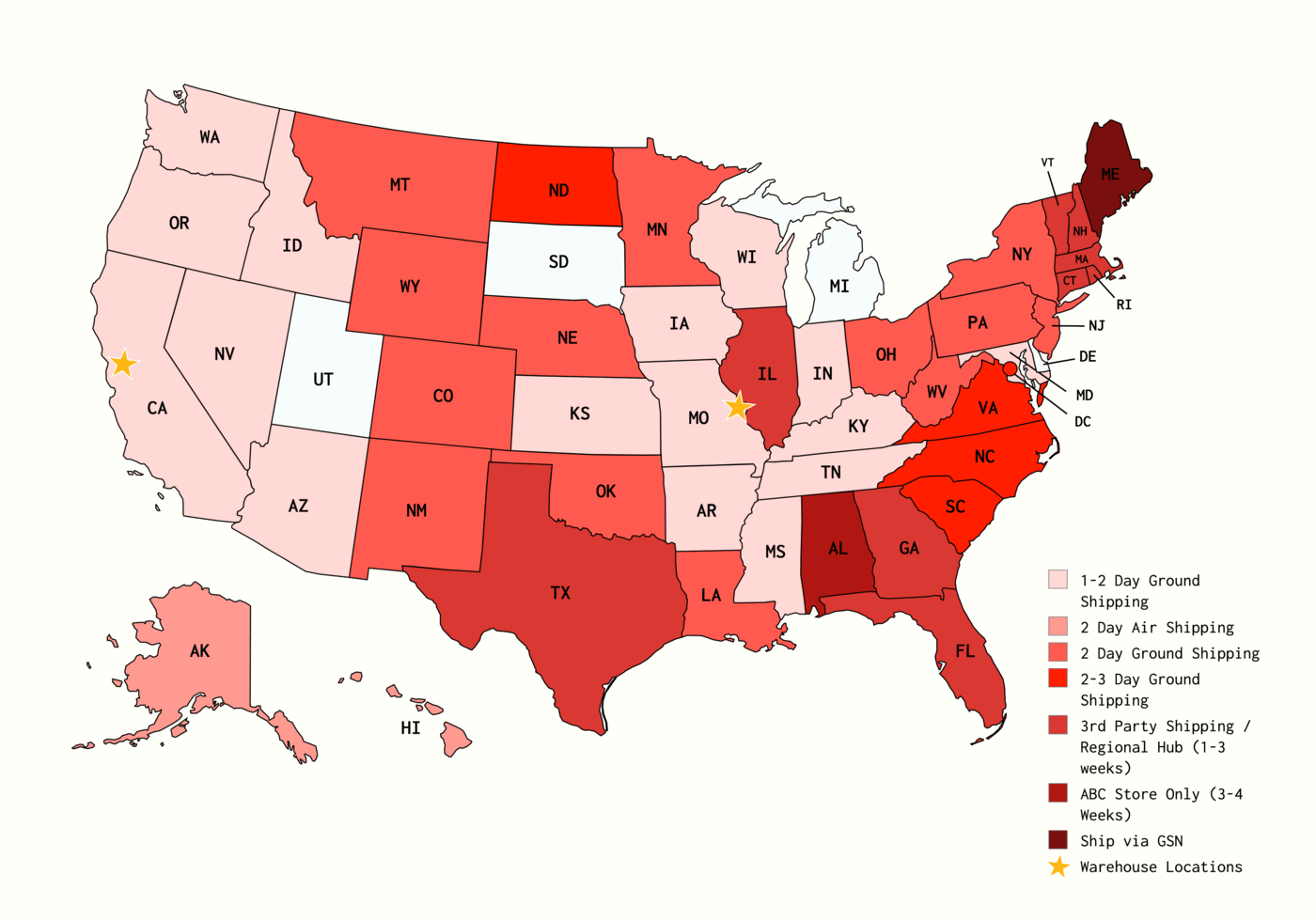
Fulfillment & Transit Times
Please note that the below map is not reflective of where we hold permits or licenses at any given time. Due to ever changing direct-shipping laws and regulations, the states that we ship to are subject to change without notice. Shipping times may change as a result of inclement weather.
Again, these are only estimates. Ground delivery may be faster or slower than this. If you are experiencing a delay, please check your tracking link, as there may be an issue with delivery that must be addressed with the delivery service.
Note that orders from our Marathon sales take longer to coordinate and ship. For detailed information on our Marathon shipping process, please view our infographic.
Last Bottle Network Infographic: Please note we are currently operating our summer network configuration - additional states are serviced via our Regional Hub Network in summer conditions to allow us to maintain temp-controlled conditions for your bottles close to your delivery address.
For any additional shipping questions not addressed below, email help@lastbottlewines.com.


